Drop a Pant Size in a Month for Reunion: Proven Data (2026)
Drop a Pant Size in a Month for Reunion: Proven Data (2026)
Sources: Egger & Dobson, Int J Obes (2000) and CDC (2025)
Key Takeaways
Here is what the evidence says about whether you can realistically drop a pant size in a month for reunion:
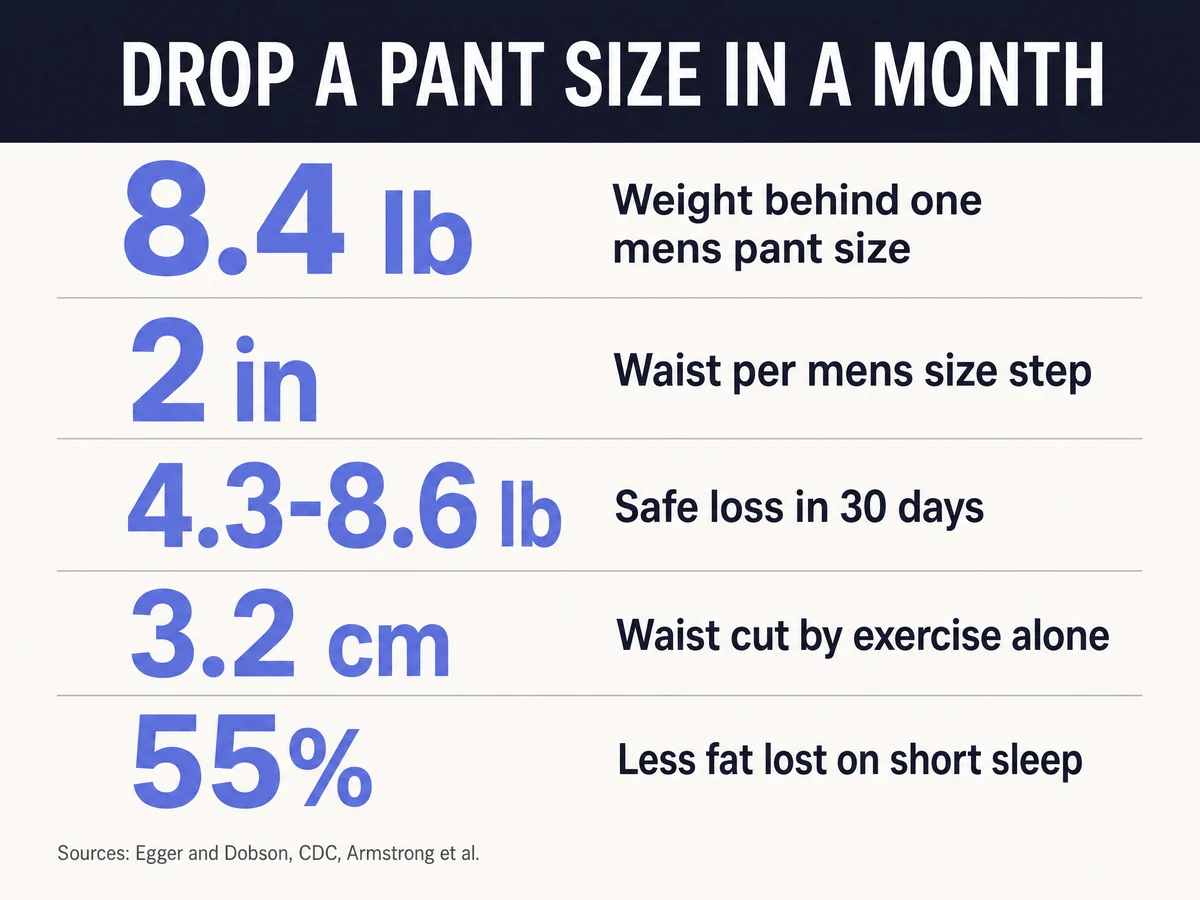
- → A men’s pant size is 2 inches of waist. Women’s misses sizes step in roughly 1–1.5 inch increments, which makes a single size drop materially easier in women’s sizing (US apparel size charts, 2025)
- → Each centimetre of waist loss tracked about 0.75 kg of body weight in men — roughly 4.2 lb per inch (Egger & Dobson, 2000)
- → CDC pace of 1–2 lb per week caps a 30-day window at 4.3–8.6 lb (CDC, 2025)
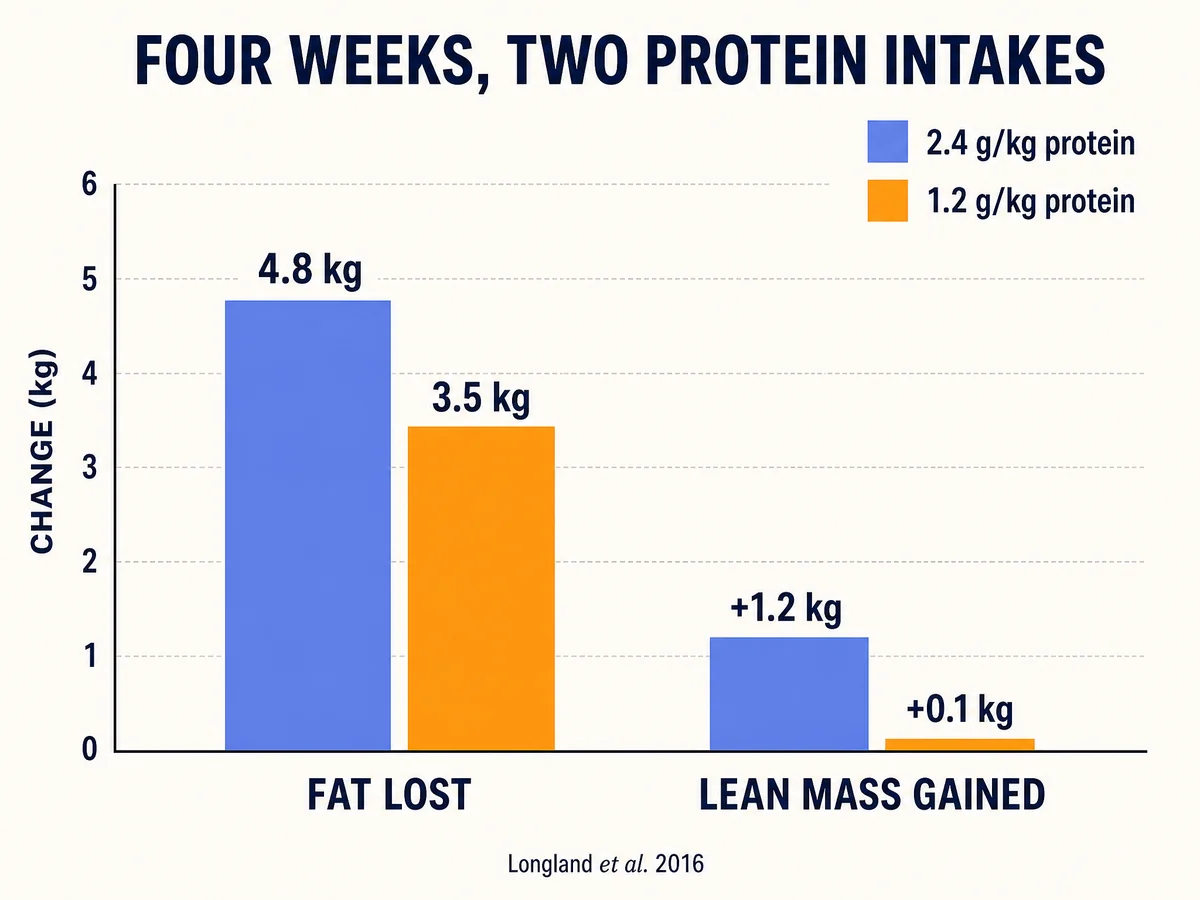
- → In four weeks, men on a 40% deficit eating 2.4 g/kg protein lost 4.8 kg of fat and gained 1.2 kg of lean mass; the lower-protein arm lost 3.5 kg (Longland et al., 2016)
- → Sleeping 5.5 hours instead of 8.5 cut the share of weight lost as fat by 55% on identical calories (Nedeltcheva et al., 2010)
- → Aerobic exercise alone reduced waist circumference by 3.2 cm versus control across 25 trials and 1,686 people (Armstrong et al., 2022)
- → Dress pants all labelled size 36 measured anywhere from 37 to 41 inches at the waistband (Esquire, 2010)
- → Ten years after a lifestyle trial, body weight had returned to baseline but waist circumference had not (Klein et al., Circulation, 2026)
You want to drop a pant size in a month for reunion, and every article you have found answers with a meal plan instead of a number. The number decides whether the goal is comfortable, borderline, or arithmetically impossible before you start. The short version: it depends almost entirely on whether you wear men’s or women’s sizing, and most people asking have never been told that.
1 How much weight is one pant size, really?
A men’s pant size is a two-inch waist step, worth roughly 8.4 pounds at the most widely cited conversion ratio. A women’s misses size is a one to one-and-a-half inch step, worth roughly 4 to 6 pounds. Published estimates range from about 3 to 8.5 pounds per inch depending on the population studied.
Two published regressions dominate this question, and both are old. Egger and Dobson measured the relationship in men in 2000 and found that a one-centimetre waist loss corresponded on average to about three-quarters of a kilogram of body weight. No superseding study has re-measured it in a modern cohort, which is precisely the data gap this page exists to fill.
| Metric | Value | Source |
|---|---|---|
| Body weight per 1 cm of waist loss (men) | ~0.75 kg | Egger & Dobson, Int J Obes (2000) |
| Body weight per 1 inch of waist loss (men, derived) | ~4.2 lb | Derived from Egger & Dobson (2000) |
| Weight-to-waist regression (men) | 0.734 kg/cm, r² 55.4% | Egger & Dobson, Int J Obes (2000) |
| Weight-to-waist regression (women) | 0.85 × cm − 2.09 = % lost | Han et al., Int J Obes (1997) |
| Men’s pant size increment | 2 in | US apparel size charts (2025) |
| Women’s misses size increment | 1–1.5 in | US apparel size charts (2025) |
| Waist reduction target proposed for women | 5–10 cm | Han et al., Int J Obes (1997) |
The women’s equation behaves differently. Han and colleagues studied 110 women in 1997 and produced a formula with a negative intercept, which means it only holds across the 5 to 10 centimetre range the authors proposed as a realistic target. Run it at 10 centimetres and it predicts a 6.4% body-weight loss — for a 170-pound woman, about 11 pounds across nearly four inches of waist, or closer to 2.8 pounds per inch. That is a very different exchange rate from the men’s figure, and it is not a measurement error. It reflects different body-fat distribution, different starting circumferences, and different populations.
Budget a range, not a point estimate: 8 to 10 pounds in men’s sizing, 4 to 6 in women’s. And measure your waist with a tape at the start, because it is the only number in this exercise that is standardised.
2 Does 30 Days Give You Enough Runway to Drop a Pant Size in a Month for Reunion?
Thirty days is 4.29 weeks. At the CDC’s recommended 1 to 2 pounds per week, that allows 4.3 to 8.6 pounds. A women’s size step fits comfortably inside that window. A men’s size step needs 8.4 pounds, which requires holding the top of the range for four consecutive weeks with no slippage.
The CDC’s position is that people who lose weight gradually, at roughly one to two pounds a week, are more likely to keep it off. The agency also names the arithmetic behind it: about 3,500 calories per pound, which puts the corresponding daily deficit at 500 to 1,000 calories. The NIH frames the lower end the same way, noting that a 500-calorie daily shortfall produces roughly a pound a week and that pairing restriction with activity tends to work better than either alone.
| Metric | Value | Source |
|---|---|---|
| Recommended rate of weight loss | 1–2 lb/week | CDC (2025) |
| Daily deficit for that rate | 500–1,000 kcal | CDC (2025) |
| Deficit producing ~1 lb/week | 500 kcal/day | NIH News in Health (2022) |
| Maximum loss in 30 days at guideline pace | 4.3–8.6 lb | Derived from CDC rate guidance |
| Men’s size step requirement | ~8.4 lb | Derived from Egger & Dobson (2000) |
| Women’s size step requirement | ~4–6 lb | Derived from Egger & Dobson (2000) |
Notice what the men’s row implies: the requirement and the ceiling are the same number. That is a reason to stop treating four weeks as the default rather than to abandon the goal. At six weeks out, the same result drops to a comfortable 1.4 pounds per week. The usual failure here is not insufficient effort — it is a timeline that leaves no room for a birthday dinner, a work trip, or a bad week of sleep.
The temptation at this point is to widen the deficit instead of the timeline. The evidence argues against it. When researchers compared fast and slow weight loss producing the same total 5 to 10% reduction, the slower group ended up with greater waist reduction, greater fat-mass loss, and less lean-mass loss. Going harder can produce a smaller waist reduction for the same pounds. It is worth knowing how to size a deficit against your own maintenance intake before you pick a number, and worth understanding what happens at the aggressive end of that range rather than guessing.
3 Why week one lies and week two tells the truth
Glycogen stores about 3 grams of water per gram. Depleting a full adult store of roughly 500 g releases about 1,500 g of water with it — close to 5 pounds of scale weight that was never fat. Roughly 70% of what you lose in the first days is water and glycogen.
This single mechanism explains more abandoned four-week plans than any other. The National Lipid Association’s scientific statement attributes early low-carbohydrate weight loss largely to body water, through two routes: glycogen depletion, and increased sodium and water excretion as insulin falls. The scale rewards you enormously in week one and then appears to stop working entirely.
Two consequences follow. Do not set your weekly target from week one, or you will chase a rate that does not exist and be tempted to cut further to hit it. And the effect runs in reverse: reintroduce carbohydrates and the water returns, adding several pounds in days without adding any fat. This is why the tape measure beats the scale for this particular goal — you are not trying to hit a number, you are trying to fit a garment, and garment fit follows circumference.
4 What four-week studies actually produced
In the best-controlled four-week trial available, young men on a 40% energy deficit training six days a week lost 4.8 kg of fat on high protein and 3.5 kg on lower protein. That is 10.6 and 7.7 pounds of fat respectively — enough for a men’s size step, under supervised conditions most people cannot replicate.
Longland and colleagues ran exactly the experiment this question needs: 40 young men, four weeks, a marked energy deficit, and six training days per week combining resistance circuits and sprint intervals. Both arms lost substantial fat. The higher-protein arm at 2.4 g/kg per day also gained 1.2 kg of lean mass while doing it. Strength gains were identical between the groups, meaning the extra protein bought body composition, not performance.
Treat that as a ceiling rather than an expectation. The participants were young men with supervised training and provided meals. What the broader literature offers is a more transferable picture of how much waist each lever removes on its own.
Three things stand out. Vigorous intensity removed about 1.7 centimetres more waist than moderate — two-thirds of an inch, same activity category. Diet did more of the heavy lifting: adding diet to an exercise programme removed 3.00 centimetres, while adding exercise to a diet removed 1.68. And one structural advantage works in your favour — across 89 studies the percentage decrease in visceral fat consistently exceeded that of subcutaneous fat. Abdominal fat is mobilised preferentially, which is why the waistband often loosens ahead of the scale, and why waist-specific goals respond faster than general weight goals.
5 The two multipliers most people skip
Protein intake and sleep duration change what you lose without changing how much you lose. Short sleep cut the share of weight lost as fat by 55% on identical calories. Higher protein flipped a four-week deficit from lean-mass-neutral to lean-mass-positive.
Nedeltcheva and colleagues put ten overweight adults through two 14-day periods of identical calorie restriction, varying only sleep opportunity. Total weight lost was the same in both conditions. What differed was the composition: 1.4 kg of fat lost on 8.5 hours versus 0.6 kg on 5.5 hours, alongside a 60% increase in fat-free mass loss and measurably more hunger. Same scale reading, worse outcome, harder to sustain.
The third multiplier is unglamorous and better evidenced than either. In the Weight Loss Maintenance trial, 1,685 adults were followed for six months; those who kept daily food records lost about twice as much weight as those who kept none. Average loss across the cohort was around 13 pounds, and 69% lost at least nine. The mechanism is not mysterious — recording intake reduces it — but the effect size is larger than almost any dietary composition variable ever tested.
That ordering matters on a four-week timeline. Tracking intake, sleeping properly, and hitting a protein target will move your waist more than optimising which diet you follow. If you have stalled around week three before, the cause is usually one of those three rather than the diet itself, and the fix is rarely a deeper deficit.
6 Your pant size is not a measuring tape
There is no enforced US sizing standard. Esquire measured dress pants all labelled size 36 and found actual waistbands from 37 to 41 inches. CBC Marketplace found most men’s jeans ran 1 to 2 inches larger than the brand’s own published size guide.
This is the part that reframes the whole goal. If you are targeting a labelled size rather than a measurement, you may be targeting a moving object. A five-inch spread across garments carrying the same number means the difference between two brands can exceed the entire biological change you are trying to produce in a month.
| Metric | Value | Source |
|---|---|---|
| Measured waistband range on pants labelled 36 | 37–41 in | Esquire, via FlowingData (2010) |
| Men’s jeans deviation from brand’s own size guide | 1–2 in larger | CBC Marketplace (2022) |
| Jeans tested that matched their size 38 label | 2 of the set | CBC Marketplace (2022) |
The Esquire figures are from 2010 and survive only through secondary reproduction, since the original article is no longer live — treat the exact numbers as indicative rather than current. The CBC Marketplace testing from 2022 points the same direction with fresher data, and no enforced standard has appeared since.
So measure the garment you actually want to wear, at the waistband, with a tape. That gives you a real target instead of a label — and if the goal is a suit or a pair of jeans already in your closet, the gap between your waist and that garment is the only number that matters. Rise matters too: a mid-rise pair crosses your body at a different circumference than a low-rise pair, which is part of why the same nominal size fits differently across styles.
Reunion gap calculator
Enter your current waist measurement, the waist you need to hit, and the days remaining. The calculator returns the required weekly rate and flags whether it sits inside evidence-based guidance.
How much runway do you actually have?
If the calculator returns a rate above two pounds per week, the useful response is almost always to extend the deadline rather than deepen the deficit — both because the slower-loss data shows better waist outcomes for the same total loss, and because a rate you cannot hold produces a rebound you will still be carrying at the next reunion. There are reliable signs that a deficit has been set too aggressively, and they show up well before the deadline does.
Methodology
Figures on this page were compiled from primary research literature, government health agencies, and published consumer testing. Where a statistic circulates widely without a traceable primary source, it was either excluded or explicitly flagged. Derived values — such as pounds per inch of waist — are labelled as derived and the underlying published ratio is shown alongside.
- Sources consulted: 41 across peer-reviewed journals, meta-analyses, government agencies, and consumer testing
- Sources cited: 19
- Data range: 1997 to July 2026
- Freshness: 2 current-year sources, 3 from the past year, 14 older — see limitation below
- Last verified: 27 July 2026
- Update schedule: Annually, or whenever a new waist-to-weight regression is published
Limitations. The core waist-to-weight conversion literature is genuinely old. Egger and Dobson (2000) and Han et al. (1997) remain the most directly applicable published regressions, and no superseding study has re-measured the relationship in a modern cohort. Both were conducted in specific populations — Australian men and Caucasian women aged 18 to 68 respectively — and both sets of authors explicitly flag wide individual variation. Apparel sizing data is patchy because no enforced US sizing standard exists to measure against. The Esquire measurements survive only through secondary reproduction. Treat every conversion figure here as a planning range, not a personal prediction.
Frequently asked questions
How much weight do I need to lose to drop one pant size?
For men, one size is a two-inch waist step. Using the ratio measured by Egger and Dobson in 2000 — about 0.75 kg of body weight per centimetre of waist — that works out to roughly 8.4 pounds. Women’s misses sizes step in one to one-and-a-half inch increments, so a single size drop is closer to 4 to 6 pounds. Individual variation is wide.
Is it realistic to drop a pant size in a month for reunion?
For women, comfortably yes. For men, it sits right at the ceiling. CDC guidance is 1 to 2 pounds per week, which caps a 30-day window at 4.3 to 8.6 pounds — and a men’s two-inch size step needs about 8.4. There is no margin for a bad week. With six weeks rather than four, the same result becomes routine rather than borderline.
Why did I lose 5 pounds the first week and almost nothing the second?
Glycogen holds about 3 grams of water per gram. A full adult store of roughly 500 g carries about 1,500 g of water with it, so depleting it drops close to 5 pounds that was never fat. Week one is a one-time payout; week two is your actual rate showing up, and it is the number worth planning around.
Does protein intake actually change the result in four weeks?
Measurably. In a four-week trial, men at 2.4 g/kg of protein lost 4.8 kg of fat and gained 1.2 kg of lean mass; the arm at 1.2 g/kg lost 3.5 kg and gained 0.1 kg. A 2025 meta-regression puts the point where fat-free mass loss stops at roughly 1.9 g/kg of body mass per day.
Can I just buy pants that fit instead?
Partly, and the data is on your side. Esquire measured dress pants all labelled size 36 and found actual waistbands ranging from 37 to 41 inches. CBC Marketplace found most men’s jeans ran 1 to 2 inches larger than the brand’s own size guide. Your tag size is a marketing decision, not a measurement.
Will cardio or diet shrink my waist faster?
Diet does more of the work, but the combination wins. Across 25 randomised trials, aerobic exercise alone cut waist circumference by 3.2 cm versus control. A network meta-analysis found adding diet to exercise removed a further 3.00 cm, while adding exercise to diet removed a further 1.68 cm.
Does sleep really affect a four-week cut?
It changes what you lose, not how much. Over 14 days of identical calorie restriction, participants sleeping 5.5 hours lost 0.6 kg of fat versus 1.4 kg on 8.5 hours — a 55% drop — while losing 60% more lean mass and reporting more hunger. Same scale reading, worse result.
If I regain the weight after the reunion, was it pointless?
Not entirely. A 2026 MRI follow-up of 366 people found that ten years on, body weight had returned to baseline on average — but waist circumference and abdominal fat depots had not, and the visceral fat reduction was associated with 28% lower type 2 diabetes risk. That said, planning the exit from a deficit matters as much as planning the entry.
Sources and references
- Egger G, Dobson A. “Clinical measures of obesity and weight loss in men.” International Journal of Obesity 24:354–357. nature.com. Accessed 27 July 2026.
- Han TS, Richmond P, Avenell A, Lean MEJ. “Waist circumference reduction and cardiovascular benefits during weight loss in women.” International Journal of Obesity. pubmed.ncbi.nlm.nih.gov. Accessed 27 July 2026.
- Centers for Disease Control and Prevention. “Steps for Losing Weight.” cdc.gov. Accessed 27 July 2026.
- National Institutes of Health. “Healthy Weight Control.” NIH News in Health. newsinhealth.nih.gov. Accessed 27 July 2026.
- Longland TM, Oikawa SY, Mitchell CJ, Devries MC, Phillips SM. “Higher compared with lower dietary protein during an energy deficit combined with intense exercise promotes greater lean mass gain and fat mass loss.” American Journal of Clinical Nutrition. ajcn.nutrition.org. Accessed 27 July 2026.
- Refalo MC, Trexler ET, Helms ER. “Effect of Dietary Protein on Fat-Free Mass in Energy Restricted, Resistance-Trained Individuals.” Strength and Conditioning Journal, 2025. journals.lww.com. Accessed 27 July 2026.
- Nedeltcheva AV, Kilkus JM, Imperial J, Schoeller DA, Penev PD. “Insufficient sleep undermines dietary efforts to reduce adiposity.” Annals of Internal Medicine 153:435–441. pubmed.ncbi.nlm.nih.gov. Accessed 27 July 2026.
- Armstrong A, Jungbluth Rodriguez K, Sabag A, et al. “Effect of aerobic exercise on waist circumference in adults with overweight or obesity.” Obesity Reviews, 2022. pubmed.ncbi.nlm.nih.gov. Accessed 27 July 2026.
- Schwingshackl L, Dias S, Hoffmann G. “Impact of long-term lifestyle programmes on weight loss and cardiovascular risk factors in overweight/obese participants.” Systematic Reviews, 2014. ncbi.nlm.nih.gov. Accessed 27 July 2026.
- Merlotti C, Ceriani V, Morabito A, Pontiroli AE. “Subcutaneous fat loss is greater than visceral fat loss with diet and exercise, weight-loss promoting drugs and bariatric surgery.” International Journal of Obesity, 2017. nature.com. Accessed 27 July 2026.
- Kirkpatrick CF, Bolick JP, Kris-Etherton PM, et al. “Review of current evidence and clinical recommendations on the effects of low-carbohydrate and very-low-carbohydrate diets.” Journal of Clinical Lipidology, National Lipid Association, 2019. sciencedirect.com. Accessed 27 July 2026.
- Hollis JF, Gullion CM, Stevens VJ, et al. “Weight Loss During the Intensive Intervention Phase of the Weight-Loss Maintenance Trial.” American Journal of Preventive Medicine / Kaiser Permanente Center for Health Research, 2008. research.kpchr.org. Accessed 27 July 2026.
- Klein H, et al. “Lifestyle-induced visceral fat loss: 5- and 10-year MRI-assessed Follow Interventions Trials (FIT).” Circulation, 2026. eurekalert.org. Accessed 27 July 2026.
- Sauer A. “Are your pants lying to you? An investigation” (data reproduced by FlowingData). Esquire, 2010. flowingdata.com. Accessed 27 July 2026.
- CBC Marketplace. “These jeans all say they’ll fit a 34-inch waist. Here’s why most of them won’t.” 2022. cbc.ca. Accessed 27 July 2026.
- Ashtary-Larky D, et al. “Waist Circumference to Height Ratio: Better Correlation with Fat Mass Than Other Anthropometric Indices During Dietary Weight Loss in Different Rates.” International Journal of Endocrinology and Metabolism, 2018. pmc.ncbi.nlm.nih.gov. Accessed 27 July 2026.
- Moving Medicine. “Obesity — reduces waist circumference: evidence summary.” 2026. movingmedicine.ac.uk. Accessed 27 July 2026.
- Size.ly. “Pants Size Chart for Men and Women (Waist in Inches + cm).” 2025. size.ly. Accessed 27 July 2026.
- California State University Pressbooks. “Healthy Long Term Weight Management,” Nutrition and Physical Fitness. pressbooks.calstate.edu. Accessed 27 July 2026.
This article is general information, not medical or dietary advice for any individual. Conversion figures are population averages with wide individual variation. If you have a medical condition, take prescription medication, or have a history of disordered eating, speak with a doctor or registered dietitian before starting a calorie deficit.
Last updated: 27 July 2026 · Next scheduled review: July 2027