Burn Belly Fat After 70: High-Protein Tips for Seniors
Metabolic Friction · How-To · 2026
Yes, you can burn belly fat after 70 — the evidence-based approach combines 1.0 to 1.5g of protein per kilogram of body weight daily, split into 25-30g doses per meal, paired with resistance training and a modest 300-500 calorie daily deficit, so you lose fat without losing the muscle you need to stay independent.
Key Takeaways
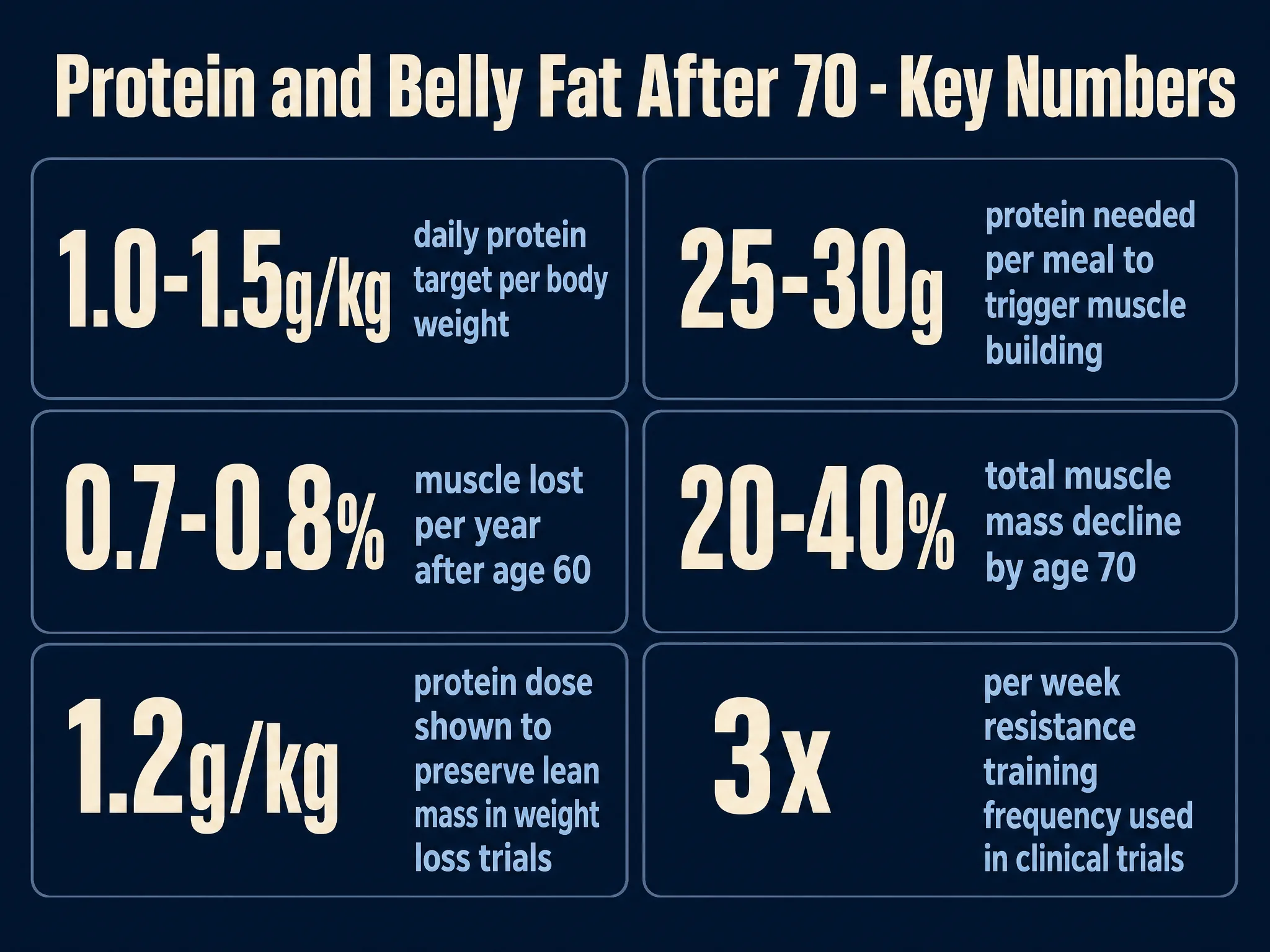
- Adults over 65 need 1.0-1.5g/kg of protein daily — well above the standard 0.8g/kg RDA — per the PROT-AGE Study Group position paper.
- Muscle mass declines by roughly 0.7-0.8% per year after age 60, and 20-40% cumulatively by age 70, which is why aggressive dieting backfires for seniors — JCI aging metabolism review.
- Older adults need 25-30g of protein per meal (about 2.5-2.8g leucine) to trigger the same muscle-building response a younger adult gets from less — a phenomenon called anabolic resistance.
- In a 10-week randomized trial of 100 adults aged 55-80, the high-protein group preserved significantly more lean mass than the normal-protein group during weight loss (effect size 0.95kg) — Verreijen et al., 2017.
- A 160-person NEJM trial found combined aerobic-plus-resistance training preserved the most physical function during weight loss in obese older adults — Villareal et al.
- A modest calorie deficit (roughly 300-500 kcal/day) paired with protein and strength training is safer for seniors than aggressive restriction, which risks accelerating muscle and bone loss.
- Anyone over 70 starting a weight-loss plan, especially with kidney disease, diabetes, or on medication, should get medical clearance first — this article is educational, not medical advice.
Belly fat after 70 behaves differently than it did at 40. This guide walks through why, exactly how much protein you need, what a safe deficit looks like, and how to structure meals and training so the fat comes off without your muscle going with it. If you’d rather see how a metabolism-support product fits into this kind of plan, our CitrusBurn review breaks down what it does and doesn’t do — worth a look after you’ve read the protein basics below. (See our affiliate disclosure.)
Why Is It Different to Burn Belly Fat After 70?
After 70, the body redistributes fat toward the abdomen while simultaneously losing muscle, a combination researchers call sarcopenic obesity. Cross-sectional data show muscle mass falls by about 0.7% to 0.8% per year after age 60, and by age 70 total muscle mass is down 20-40% from its peak, according to a body-composition review in the Journal of Endocrinology.
At the same time, visceral fat — the fat around the organs, not just under the skin — increases with age even when body weight stays flat. This visceral fat is metabolically active tissue linked to elevated cardiovascular and stroke risk in adults around age 70, per a Swedish cohort study of over 3,000 people. That combination — less muscle, more visceral fat — is why generic “eat less, move more” advice often fails seniors: cutting calories without enough protein and resistance training accelerates the muscle loss that’s already happening, and the scale can drop while the metabolic problem (visceral fat, low muscle) barely improves.
How Much Protein Do You Need After 70 to Burn Belly Fat?
Most healthy adults over 65 should aim for 1.0 to 1.5g of protein per kilogram of body weight per day, roughly 68-100g daily for someone weighing 150-180 pounds. That range comes from the PROT-AGE Study Group, an international panel of aging and nutrition researchers, and is echoed by Consumer Reports’ guidance of 0.45-0.55g per pound of body weight for people over 65.
Total daily protein isn’t the whole story — distribution matters just as much. Because aging blunts the muscle’s response to protein (anabolic resistance), older adults need a bigger dose per meal to get the same effect a younger adult gets from less. PROT-AGE puts that per-meal anabolic threshold at 25 to 30g of protein containing about 2.5-2.8g of leucine — well above the 6.9g the average older adult eats at breakfast, according to a 2023 study of protein timing in older adults with type 2 diabetes.
Protein Targets by Meal
| Meal | Typical Older-Adult Intake | PROT-AGE Target |
|---|---|---|
| Breakfast | ~7g protein | 25-30g protein |
| Lunch | ~29g protein | 25-30g protein |
| Dinner | ~21g protein | 25-30g protein |
The gap is almost always at breakfast. Closing it — with eggs, Greek yogurt, or a protein shake — is usually the single highest-leverage change a senior can make to their daily protein distribution.
What Does a High-Protein Day Look Like for a Senior?
Whole foods should do most of the work, with supplements filling genuine gaps rather than replacing meals. Here’s roughly what 90-100g of well-distributed daily protein looks like using common foods (values from USDA FoodData Central):
| Food | Serving | Protein |
|---|---|---|
| Greek yogurt (plain, nonfat) | 1 cup | ~22g |
| Eggs | 2 large | ~12g |
| Chicken breast, cooked | 3 oz | ~26g |
| Cottage cheese | 1 cup | ~25g |
| Salmon, cooked | 3 oz | ~22g |
| Lentils, cooked | 1 cup | ~18g |
| Whey protein powder | 1 scoop (30g) | ~24g |
A simple pattern: eggs and Greek yogurt at breakfast (roughly 30g), chicken or fish with vegetables at lunch (roughly 30g), and lentils or cottage cheese with dinner (roughly 25g) gets most people into the target range without any powders at all. If appetite is the limiting factor — common after 70 — a whey or plant-protein supplement between meals is a reasonable way to close the gap, which is where some readers look at options like our CitrusBurn review for a metabolism-support angle alongside the protein basics; it’s not a replacement for the food targets above, just an adjunct some people add on top of them.
Is It Safe to Lose Belly Fat Quickly After 70?
No — a modest, gradual deficit is safer and more effective than aggressive restriction for adults over 70. Intentional weight loss without enough protein and resistance exercise is itself a risk factor for accelerated muscle loss in older adults, per the Verreijen 2017 trial. Clinical protocols for obese older adults have used supervised deficits of 750-1,000 kcal/day, but that level of restriction was paired with close medical monitoring and structured exercise — not something to self-prescribe. For most healthy seniors managing their own routine, a 300-500 kcal/day deficit is a more sustainable and lower-risk starting point.
If your weight has stalled despite a deficit, or you’re not sure whether your restriction is too aggressive, it’s worth reading through the warning signs of an excessive calorie deficit before pushing further — several of those signs (fatigue, hair thinning, poor sleep) show up faster in older adults than in younger dieters.
Should Seniors Combine Resistance Training With High Protein for Belly Fat Loss?
Yes — resistance training is what determines whether the weight you lose is fat or muscle. In a five-month trial of 126 adults aged 65-79, participants who combined resistance training with a calorie deficit lost fat mass in both groups, but only the group also restricting calories lost any lean mass, and even that loss was smaller than in typical diet-only weight loss, according to the I’M FIT trial. A separate 12-week trial using resistance and impact training during an active calorie deficit improved gait speed more than aerobic training alone in adults over 60 with obesity, per a study published in PMC.
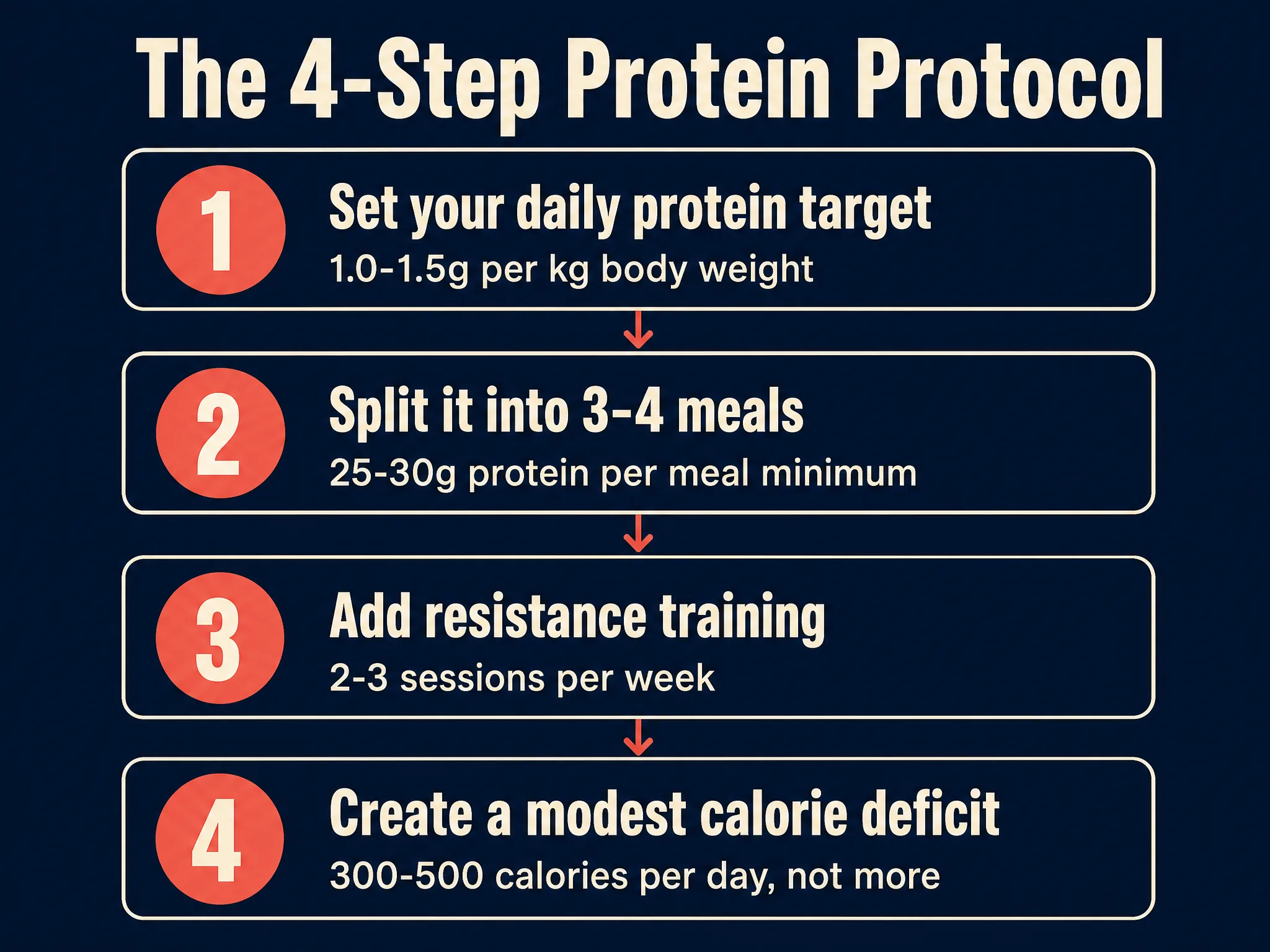
The 4-Step Protocol
- Set your daily protein target. Calculate 1.0-1.5g per kg of body weight (multiply your weight in pounds by 0.45-0.68).
- Split it across 3-4 meals. Aim for at least 25-30g of protein per meal, prioritizing breakfast since it’s usually the lowest.
- Add resistance training 2-3x per week. Bodyweight, resistance bands, or light weights all count — consistency matters more than intensity.
- Create a modest deficit. 300-500 kcal/day below maintenance, tracked loosely rather than obsessively.
Can Too Much Protein Hurt Your Kidneys After 70?
For most healthy older adults, no — but it’s a real consideration if you have existing kidney disease. Higher protein intake in the 1.0-1.5g/kg range is generally considered safe for people with normal kidney function, but it could exacerbate chronic kidney disease, so anyone with CKD, diabetes-related kidney concerns, or on diuretics or ACE inhibitors should work with a dietitian before increasing protein intake, per guidance summarized by Consumer Reports. This is exactly the kind of decision worth a quick conversation with your physician rather than guessing.
What Goes Wrong When Seniors Try to Lose Belly Fat?
The most common mistake is cutting calories aggressively while protein and training stay the same, which accelerates the muscle loss already happening from aging. The second most common mistake is the opposite problem — chasing “clean eating” without ever getting into a calorie deficit at all, so belly fat doesn’t move regardless of food quality. A smaller but frequent issue is inconsistent protein distribution: hitting 100g of protein in a single dinner does far less for muscle protein synthesis than the same 100g spread across three meals, because of the per-meal anabolic threshold discussed above.
If the scale genuinely isn’t moving despite tracking food and exercise, our deficit troubleshooting guide walks through the most common hidden causes — inaccurate tracking, water retention, and metabolic adaptation among them.
Where a Supplement Fits In
None of the above requires a supplement — food and consistency do the heavy lifting. But if appetite, time, or convenience make it hard to hit your protein or metabolism-support goals through food alone, some readers use products like CitrusBurn as an add-on to the plan above, not a substitute for it.
Frequently Asked Questions
Can you actually burn belly fat after 70?
Yes. It requires a modest calorie deficit, adequate protein (1.0-1.5g/kg/day), and resistance training — the same physiological principles that apply at any age, just with tighter margins for error because muscle loss happens faster once you’re past 70.
How much protein do I need after 70 to lose belly fat?
Most healthy older adults should target 1.0-1.5g of protein per kilogram of body weight daily, spread across 3-4 meals with at least 25-30g per meal, per PROT-AGE Study Group recommendations.
Is it safe to lose weight quickly after 70?
Rapid weight loss is riskier after 70 because it can accelerate muscle and bone loss. A gradual 300-500 kcal/day deficit combined with resistance training is a safer default than aggressive restriction.
Do I need to lift weights to lose belly fat after 70?
You don’t need a gym, but some form of resistance training — bands, bodyweight, or light dumbbells, 2-3 times a week — significantly improves how much of the weight you lose is fat versus muscle.
Can too much protein hurt my kidneys?
Not typically if your kidneys are healthy, but existing kidney disease changes the calculation. Talk to your doctor before raising protein intake if you have CKD, diabetes complications, or take medications that affect kidney function.
What’s a good high-protein breakfast for seniors?
Two eggs plus a cup of plain Greek yogurt gets you to roughly 30-34g of protein, which meets the per-meal anabolic threshold most older adults miss at breakfast.
How fast should belly fat loss happen after 70?
About 0.5-1 pound per week is a reasonable, sustainable pace for most older adults — faster than that increases the risk of losing muscle along with fat.
Should I take a protein supplement or just eat whole foods?
Whole foods should cover most of your protein target. A supplement makes sense as a gap-filler when appetite is low or a meal falls short, not as a primary protein source.
Methodology: Claims in this article are sourced from peer-reviewed studies (PROT-AGE Study Group, JCI, NEJM, PMC-indexed RCTs) and USDA FoodData Central for food composition values. Because this is a YMYL health topic aimed at an older, more vulnerable readership, we deliberately excluded Reddit or forum anecdotes as evidence — anonymous accounts don’t meet the evidentiary bar for medical/nutritional claims made to seniors. Every statistic links to its primary source above.