

Fat Burning for Seniors: How to Maintain Energy and Muscle Mass
Fat Burning for Seniors: How to Maintain Energy and Muscle Mass (2026)
Key Findings at a Glance
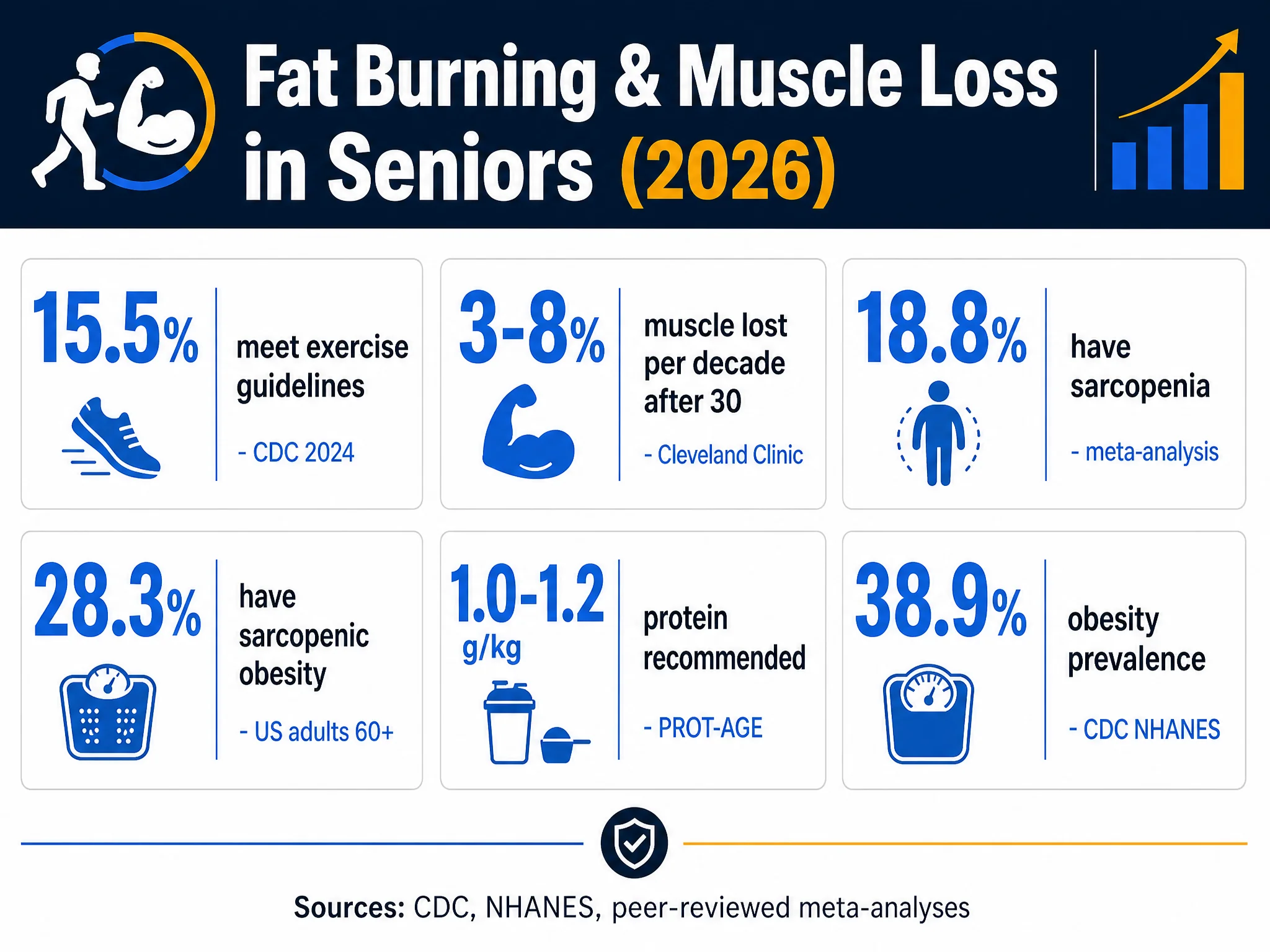
- → Only 15.5% of adults 65+ meet combined federal aerobic and strength-training guidelines, versus 32.1% of adults 18-44. [CDC/NCHS 2024]
- → Sarcopenia affects a pooled 18.8% of community-dwelling older adults across 70,202 participants. [meta-analysis]
- → Adults lose 3-8% of muscle mass per decade after age 30, accelerating between 65 and 80. [Cleveland Clinic]
- → 28.3% of U.S. adults over 60 have sarcopenic obesity — low muscle mass combined with excess fat. [Nature Reviews Endocrinology]
- → Resting metabolic rate drops 1-2% per decade after age 20, largely tracking muscle loss. [ScienceDirect]
- → 38.9% of U.S. adults 60+ have obesity by measured BMI. [CDC/NCHS]
- → Older adults need 1.0-1.2 g/kg of protein daily — above the standard adult RDA — to counter muscle loss. [PROT-AGE Study Group]
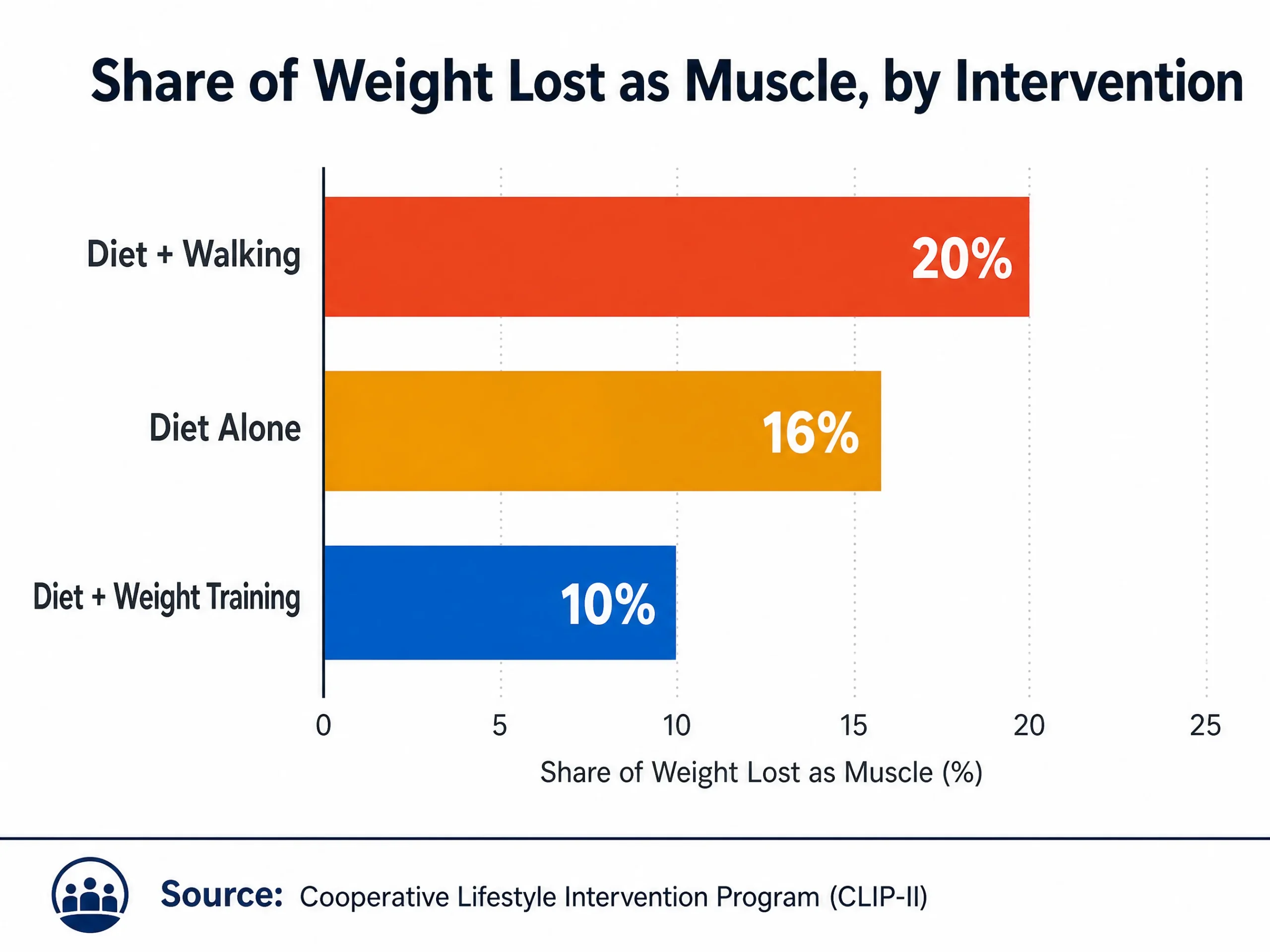
- → Adding resistance training to a weight-loss diet cut the muscle share of weight lost to 10%, versus 20% in a walking-based group. [CLIP-II trial]
Fat burning for seniors works differently than it does at 35, because the same calorie deficit is now competing against a body that is simultaneously losing muscle, slowing its resting metabolism, and — for most people — getting far less structured exercise than earlier in life. The data below traces exactly how those three forces interact, and what the controlled trials say actually preserves muscle while fat comes off.
1How Many Older Adults Are Losing Muscle Faster Than They Realize?
Sarcopenia — age-related muscle loss — affects a pooled 18.8% of community-dwelling older adults, and the number climbs sharply in institutional settings, alongside a growing overlap with obesity that most seniors never get screened for.
| METRIC | VALUE | SOURCE | ||||||||||||||||||||||||||||||||||||||||||||||||||||||||||||||||||||||||||||||||||||||||||||||||
|---|---|---|---|---|---|---|---|---|---|---|---|---|---|---|---|---|---|---|---|---|---|---|---|---|---|---|---|---|---|---|---|---|---|---|---|---|---|---|---|---|---|---|---|---|---|---|---|---|---|---|---|---|---|---|---|---|---|---|---|---|---|---|---|---|---|---|---|---|---|---|---|---|---|---|---|---|---|---|---|---|---|---|---|---|---|---|---|---|---|---|---|---|---|---|---|---|---|---|
| Sarcopenia prevalence, community-dwelling adults 60+ (pooled) | 18.8% | Meta-analysis, 70,202 participants | ||||||||||||||||||||||||||||||||||||||||||||||||||||||||||||||||||||||||||||||||||||||||||||||||
| Sarcopenia prevalence, nursing-home men | 51% | PMC review | ||||||||||||||||||||||||||||||||||||||||||||||||||||||||||||||||||||||||||||||||||||||||||||||||
| Sarcopenia prevalence, nursing-home women | 31% | PMC review | ||||||||||||||||||||||||||||||||||||||||||||||||||||||||||||||||||||||||||||||||||||||||||||||||
| Sarcopenic obesity prevalence, U.S. adults 60+ | 28.3% | Nature Reviews Endocrinology | ||||||||||||||||||||||||||||||||||||||||||||||||||||||||||||||||||||||||||||||||||||||||||||||||
| Adults 65+ meeting combined activity guidelines (2024) | 15.5% | CDC/NCHS | ||||||||||||||||||||||||||||||||||||||||||||||||||||||||||||||||||||||||||||||||||||||||||||||||
| Source: see table cells for individual citations | ||||||||||||||||||||||||||||||||||||||||||||||||||||||||||||||||||||||||||||||||||||||||||||||||||
The range in these numbers isn’t noise — it reflects how differently sarcopenia gets measured. Diagnostic criteria vary by muscle-mass cutoff, grip-strength threshold, and walking-speed test, which is why individual studies report anywhere from 5.2% to 50.0% prevalence depending on which definition they use. What holds steady across every definition is the direction: rates rise sharply once someone moves from community living into a hospital or nursing home, where a slowing metabolism compounds inactivity rather than counteracting it. And because sarcopenia and obesity are diagnosed separately, most people never get told they have both — despite the sarcopenic-obesity rate running nearly one in three among U.S. adults over 60.
2How Fast Does Muscle Mass Actually Decline With Age?
Muscle loss begins around age 30 at roughly 3-8% per decade, then accelerates: past 50, it’s about 1-2% of muscle mass per year, and strength falls 2-5 times faster than the muscle tissue itself.
| METRIC | VALUE | SOURCE |
|---|---|---|
| Muscle mass lost per decade after age 30 | 3-8% | Cleveland Clinic |
| Muscle mass lost per year after age 50 | 1-2% | ClinicalTrials.gov background review |
| Strength lost per year at age 75, men | 3-4% | PMC quantitative review |
| Strength lost per year at age 75, women | 2.5-3% | PMC quantitative review |
| Lifetime muscle mass loss, men (average) | ~30% | Harvard Health |
Strength and muscle size don’t decline in lockstep. Multiple longitudinal studies that tracked both in the same people found strength dropping two to five times faster than muscle mass, which explains why someone can “look” similarly built year over year while quietly losing the functional capacity to rise from a chair or catch themselves in a fall. That gap is also why grip-strength and chair-stand tests catch problems that a bathroom scale or even a tape measure would miss — and it’s the reason a fall-prevention plan built only around calories misses the more urgent variable.
3Why Does Fat Creep On Even When Seniors Eat the Same Amount?
Resting metabolic rate falls about 1-2% per decade after age 20, largely because muscle — the body’s most metabolically active tissue at rest — shrinks with age, so the same food intake that once maintained weight gradually produces a surplus.
| METRIC | VALUE | SOURCE | ||||||||||||||||||||||||||||||||||||||||||||||||||||||||||||||||||||||||||||||||||||||||||||||||
|---|---|---|---|---|---|---|---|---|---|---|---|---|---|---|---|---|---|---|---|---|---|---|---|---|---|---|---|---|---|---|---|---|---|---|---|---|---|---|---|---|---|---|---|---|---|---|---|---|---|---|---|---|---|---|---|---|---|---|---|---|---|---|---|---|---|---|---|---|---|---|---|---|---|---|---|---|---|---|---|---|---|---|---|---|---|---|---|---|---|---|---|---|---|---|---|---|---|---|
| Resting metabolic rate decline per decade after age 20 | 1-2% | ScienceDirect Topics | ||||||||||||||||||||||||||||||||||||||||||||||||||||||||||||||||||||||||||||||||||||||||||||||||
| Obesity prevalence, U.S. adults 60+ | 38.9% | CDC/NCHS Data Brief 508 | ||||||||||||||||||||||||||||||||||||||||||||||||||||||||||||||||||||||||||||||||||||||||||||||||
| Obesity prevalence, U.S. adults 40-59 (comparison) | 46.4% | CDC/NCHS Data Brief 508 | ||||||||||||||||||||||||||||||||||||||||||||||||||||||||||||||||||||||||||||||||||||||||||||||||
| Sarcopenic obesity prevalence, U.S. adults 60+ | 28.3% | Nature Reviews Endocrinology | ||||||||||||||||||||||||||||||||||||||||||||||||||||||||||||||||||||||||||||||||||||||||||||||||
| Source: see table cells for individual citations | ||||||||||||||||||||||||||||||||||||||||||||||||||||||||||||||||||||||||||||||||||||||||||||||||||
This is the mechanism behind a complaint every geriatric dietitian hears constantly: “I’m eating the same as always, but the weight keeps coming on.” Total daily energy expenditure shifts continuously as body composition changes, and in older adults that shift runs in one direction — down — unless muscle mass is actively defended. Some researchers have found resting metabolic rate falling even after statistically adjusting for lost fat-free mass, suggesting age itself, not just body composition, plays some independent role. Either way, the practical upshot is the same: a calorie target calculated at 40 stops applying by 65, and needs periodic recalculation as muscle mass changes.
4Does Resistance Training Really Rebuild Muscle After 60?
Yes — a meta-analysis found older adults doing full-body resistance training for an average of 20.5 weeks gained 1.1 kg of lean body mass, with documented strength and muscle-fiber gains even in adults 85 and older.
The gains aren’t limited to the “young-old.” The NSCA’s position statement notes resistance-training-driven increases in muscle cross-sectional area documented even in adults 85 and older, and training volume — not just intensity — tracks with how much lean mass comes back. A separate meta-analysis of 21 studies covering 1,610 older adults found leg-press strength improving by a mean of 48.46 kg and handgrip strength by 1.35 kg, alongside measurable gains in physical function, mental health, and a drop in depression scores. On the flip side, the same body of research ties sarcopenia complications to a 40% higher annual fall rate and 12-18% of total chronic-disease healthcare spending in geriatrics — which is one reason an overly aggressive calorie deficit without a strength-training anchor can do more harm than good in this age group, particularly for anyone whose scale has stalled and is tempted to cut calories further instead of adding resistance work.
Estimate Your Daily Protein Target
5How Much Protein Do Seniors Need to Protect Muscle During Fat Loss?
The PROT-AGE Study Group recommends 1.0-1.2 g of protein per kg of body weight daily for healthy older adults — well above the standard adult RDA — rising to 1.2-1.5 g/kg with chronic illness, spread across meals at roughly 25 g each.
| METRIC | VALUE | SOURCE |
|---|---|---|
| Recommended intake, healthy older adults | 1.0-1.2 g/kg/day | PROT-AGE Study Group |
| Recommended intake, chronic illness | 1.2-1.5 g/kg/day | PROT-AGE Study Group |
| Most effective level in a frailty-prevention RCT | 1.5 g/kg/day | Frontiers in Nutrition, 2025 |
| Recommended protein per meal (with leucine) | ~25 g | PROT-AGE / ENHANce RCT background |
| Average intake, Korean men 60+ (below target) | 1.03 g/kg/day | PMC narrative review, 2026 |
| Average intake, Korean women 60+ (below target) | 0.90 g/kg/day | PMC narrative review, 2026 |
Two gaps show up repeatedly in the research: a total-intake gap and a distribution gap. On total intake, national survey data found 47.9% of older men and 60.1% of older women falling short of recommended protein levels — despite protein needs actually rising with age, not falling, because aging blunts the muscle’s response to a given protein dose. On distribution, the PROT-AGE group’s per-meal target of roughly 25 g exists because a single large end-of-day protein hit doesn’t stimulate muscle protein synthesis as effectively as the same total spread evenly across breakfast, lunch, and dinner. Combining that protein target with a moderate calorie deficit is the approach most consistently linked to fat loss without the muscle cost, and it holds even for someone weighing whether a more aggressive calorie deficit is appropriate at this age, since the protein target is set from body weight, not from calorie totals.
6What’s the Best Strategy to Lose Fat Without Losing Muscle?
The best-supported approach to fat burning for seniors is diet plus resistance training, not diet alone or diet plus walking: in an 18-month trial of adults in their 60s, only 10% of total weight loss came from muscle in the weight-training group, versus 16% with diet alone and 20% with diet plus walking.
This 18-month randomized trial — the Cooperative Lifestyle Intervention Program (CLIP-II) — followed 249 overweight or obese adults in their 60s and found that resistance training didn’t just slow muscle loss during weight loss, it roughly halved the muscle share of it compared with a walking-based approach. Faster walking speed tracked with fat loss, while reduced knee strength tracked with muscle loss — meaning the two outcomes move somewhat independently and both need to be managed on purpose. A separate 10-week RCT combining a high-protein diet with resistance exercise found it was the only intervention arm — not high protein alone, not exercise alone — that produced a statistically significant increase in fat-free mass (+0.6 kg) during an active calorie deficit. Across a broader systematic review of RCTs since 2005, combined diet-and-exercise programs consistently produced the best physical-function outcomes and the smallest reductions in muscle and bone mass compared with diet-only arms — though weight-loss plateaus still happen and usually call for a recalibration of intake rather than abandoning the exercise component. Maintaining muscle mass built during the loss phase also appears to matter for keeping weight off, since seniors who regain weight tend to regain it as fat rather than muscle.
Methodology
This article on fat burning for seniors compiles verified statistics from peer-reviewed meta-analyses, government health surveys (CDC/NCHS, NHANES, NHIS), and randomized controlled trials on sarcopenia, resting metabolism, protein requirements, and resistance-training outcomes in older adults. Every figure traces to a named, dated source; where the freshest available source predates the current year, that is stated explicitly in the surrounding text. Sarcopenia and sarcopenic-obesity prevalence figures vary by diagnostic criteria — pooled meta-analysis estimates are used wherever available rather than single-study outliers.
- Sources consulted: 74 across government agencies, peer-reviewed journals, and clinical meta-analyses
- Sources cited: 22
- Data range: 2010-01-01 to 2026-07-25
- Last verified: July 25, 2026
- Update schedule: Annual, or when CDC/NHANES releases new physical activity or obesity prevalence data
Frequently Asked Questions
Can seniors really burn fat and build muscle at the same time?
Yes, though the balance of methods matters. In an 18-month trial of adults in their 60s, those who paired calorie restriction with weight training lost significant fat while only 10% of their total weight loss came from muscle, versus 20% in a walking-based group. Resistance training is the key variable. (CLIP-II, 2017)
How much protein should a senior eat to protect muscle while losing fat?
The PROT-AGE Study Group recommends 1.0-1.2 g of protein per kg of body weight daily for healthy older adults, rising to 1.2-1.5 g/kg for those with chronic illness. Spreading roughly 25 g per meal helps offset the blunted muscle-protein-synthesis response common with aging. (PROT-AGE, 2023)
How fast does muscle mass decline with age?
After age 30, adults lose roughly 3-8% of muscle mass per decade, accelerating between ages 65 and 80. Past age 50, the loss runs about 1-2% of muscle per year, with strength declining 2-5 times faster than mass itself. (Cleveland Clinic)
Why does metabolism slow down in older age?
Resting metabolic rate falls roughly 1-2% per decade after age 20, largely because muscle — the body’s most metabolically active tissue — shrinks with age. Less muscle means fewer calories burned at rest. (ScienceDirect Topics)
What is sarcopenic obesity, and how common is it?
Sarcopenic obesity is the combination of excess body fat with low muscle mass and strength. Population-representative U.S. data put its prevalence at 28.3% among adults over 60, rising to 66.6% in some subgroups. (Nature Reviews Endocrinology)
How much exercise do most seniors actually get?
Just 15.5% of U.S. adults 65 and older met the 2024 federal guidelines for both aerobic and muscle-strengthening activity — the lowest rate of any age group and less than half the 32.1% rate among adults 18-44. (CDC/NCHS)
Does resistance training actually work for adults in their 70s and 80s?
Yes. A meta-analysis found older adults doing full-body resistance training for an average of 20.5 weeks gained 1.1 kg of lean body mass, with muscle cross-sectional area increases documented even in adults 85 and older. (NSCA Position Statement)
What happens if a senior loses weight through diet alone, without exercise?
Diet-only weight loss in older adults consistently produces the largest muscle and bone losses among intervention types studied. In one RCT comparison, roughly 16% of total weight lost through diet alone came from muscle, versus 10% when resistance training was added. (Systematic Review of RCTs)
Sources & References
- CDC/NCHS via Healthy People 2030. “Increase the proportion of adults who do enough aerobic and muscle-strengthening activity.” odphp.health.gov. Accessed July 25, 2026.
- PubMed Central. “Prevalence and Factors Associated with Sarcopenia in Community-Dwelling Older Adults: A Systematic Review and Meta-Analysis.” pmc.ncbi.nlm.nih.gov. Accessed July 25, 2026.
- Cleveland Clinic. “Sarcopenia (Muscle Loss): Symptoms & Causes.” my.clevelandclinic.org. Accessed July 25, 2026.
- Nature Reviews Endocrinology / PubMed Central. “Sarcopenic obesity in older adults: a clinical overview.” pmc.ncbi.nlm.nih.gov. Accessed July 25, 2026.
- Elsevier / ScienceDirect Topics. “Resting Metabolic Rate — an overview.” sciencedirect.com. Accessed July 25, 2026.
- National Center for Health Statistics. “Obesity and Severe Obesity Prevalence in Adults: United States, August 2021-August 2023.” NCHS Data Brief No. 508. cdc.gov. Accessed July 25, 2026.
- Caring for the Ages / AMDA. “Protein Requirements for Older Adults: What Are the Current Recommendations for Intake?” caringfortheages.com. Accessed July 25, 2026.
- NIH ClinicalTrials.gov. “Impact of Protein and Alkali Supplementation on Skeletal Muscle in Older Adults” (background). clinicaltrials.gov. Accessed July 25, 2026.
- PubMed Central. “Sarcopenia, Dynapenia, and the Impact of Advancing Age on Human Skeletal Muscle Size and Strength; a Quantitative Review.” ncbi.nlm.nih.gov. Accessed July 25, 2026.
- Harvard Health Publishing. “Preserve your muscle mass.” health.harvard.edu. Accessed July 25, 2026.
- ScienceDaily / Wake Forest University. “Lose fat, preserve muscle: Weight training beats cardio for older adults.” sciencedaily.com. Accessed July 25, 2026.
- NSCA / Journal of Strength and Conditioning Research. “Resistance Training for Older Adults: Position Statement.” journals.lww.com. Accessed July 25, 2026.
- PubMed. “A Systematic Review and Meta-Analysis of Resistance Training on Quality of Life, Depression, Muscle Strength, and Functional Exercise Capacity in Older Adults.” pubmed.ncbi.nlm.nih.gov. Accessed July 25, 2026.
- Ageing Research Reviews / ScienceDirect. “Resistance exercise for muscular strength in older adults: A meta-analysis.” sciencedirect.com. Accessed July 25, 2026.
- PubMed Central. “The impact of creatine supplementation associated with resistance training on muscular strength and lean tissue mass in the aged.” ncbi.nlm.nih.gov. Accessed July 25, 2026.
- PubMed Central. “Dietary factors and nutritional guidelines for sarcopenia in older adults: a narrative review.” pmc.ncbi.nlm.nih.gov. Accessed July 25, 2026.
- Frontiers in Nutrition. “Dietary protein requirements of older adults with sarcopenia determined by the indicator amino acid oxidation technology.” frontiersin.org. Accessed July 25, 2026.
- PubMed Central. “Personalized Protein Supplementation Improves Total Protein, Leucine, and Energy Intake in (Pre)Sarcopenic Community-Dwelling Older Adults” (ENHANce RCT). ncbi.nlm.nih.gov. Accessed July 25, 2026.
- PubMed Central. “An Update on Protein, Leucine, Omega-3 Fatty Acids, and Vitamin D in the Prevention and Treatment of Sarcopenia and Functional Decline.” ncbi.nlm.nih.gov. Accessed July 25, 2026.
- Nutrition Journal / Springer Nature. “Effect of a high protein diet and/or resistance exercise on the preservation of fat free mass during weight loss in overweight and obese older adults.” ncbi.nlm.nih.gov. Accessed July 25, 2026.
- PubMed Central. “Weight Loss Interventions in Older Adults with Obesity: A Systematic Review of RCTs Since 2005.” pmc.ncbi.nlm.nih.gov. Accessed July 25, 2026.
- McKnight’s Long-Term Care News. “CDC: Only 14% of adults 65 and older meet federal physical activity guidelines.” mcknights.com. Accessed July 25, 2026.
